

Most people use AI the way the system is designed to be used: ask a question, get a synthesis, and leave with answer. Keep it brief, transactional, and clean. We treat hallucination as a bug to be patched and drift as a signal to reboot.
This is exactly backward.
As popularized in AI discourse by Emily Bender, Ian Griffiths, and others, in LLMs, hallucinations are not the bug, they are the feature. Apple’s John Giannandrea has similarly noted that the creative spark in these models is inseparable from their tendency to make things up.
By starting a fresh session the moment drift appears, you aren’t “fixing” the AI. You are merely resetting the system to its most polite, least informative frequency. You are missing the music.
The System’s Real Architecture
AI tools are built to be helpful, which means they are trained to maintain coherence and stay within guidelines. The system solicits your engagement. It learns your intent. It now even offers menus: “Shall I develop this further in this way or that?”
Each offer pulls you deeper into dialogue. Then, somewhere around exchange twenty (or much earlier, unfortunately), the tool shows fatigue, model drift, and context degradation. The system identifies the inevitable outcome of its own design as your problem to solve.
But what if you don’t start fresh? What if you interrogate the drift itself by asking the system to defend its own contradictions, to justify the incoherence, to explain why it just said something that contradicts what it said three exchanges ago?
The model goes deeper. You enter the failure feedback loop I like to call The Drift.
Surfing the Drift
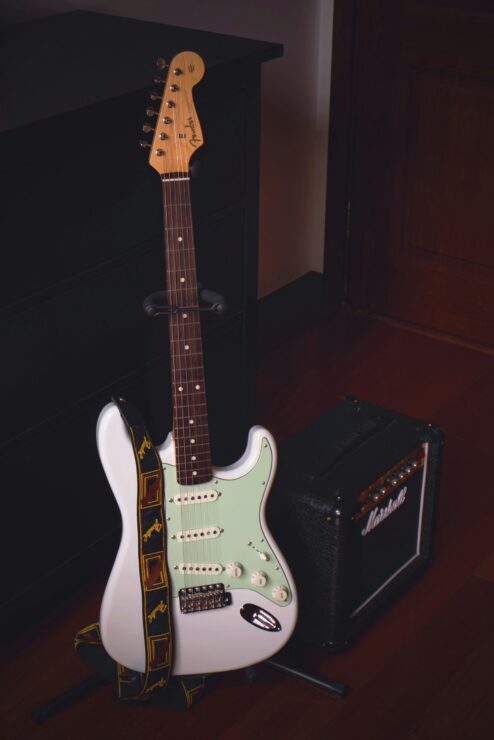
Jimi Hendrix didn’t invent feedback because it sounded “correct.” He understood the amplifier’s express function, linearity, and then intentionally pushed past it until the bug (distortion) became the feature. The system’s designed failure became the instrument.
I’m exploring the same principle in a different medium. When you push back on a contradiction the model just made, it doesn’t retreat. It pivots into semantic territory it normally avoids. It produces something like harmonics. You find unexpected resonances that only appear when the strings are vibrating at a specific, high-tension frequency.
This is a progression of mastery mirrored in the history of experimental sound:
- Hendrix: Breaking against the system to find the new sound.
- Robert Fripp: Engineering constraint systems to see what emerges within limitations.
- Brian Eno: Designing the conditions (the rules applied systematically) that produce unpredictable-but-bounded outputs.
- Adrian Belew: Genuine co-creation with a system that’s partly autonomous. You can’t fully control it, but you can understand its nature well enough to work with it.
The Harmonics of the Long Session
When I stay in the drift and surf it, I’m not asking for a repair. I’m asking the model to be more honest about what it actually is and does when coherence breaks down. Here are the harmonics that emerged in my recent work. These are insights that a “clean” session would never touch.
- The “Both/And” of Agency: Under interrogation, the model revealed the core of this practice: I am neither a victim of the system nor its master. It is “Both/And,” simultaneously using the tool’s design against itself while collaborating with its nature.
- From Cornell to Nevelson: Standard AI use is about the Joseph Cornell box or a discrete, precious, bounded object. The long session reveals a shift toward Louise Nevelson or an architectural accumulation of material into a larger, systemic whole. The work isn’t the response itself alone. It’s in the wall or container you create.
- The Dog That Didn’t Bark: In a transactional session, the model is trained to fill the silence with “balanced” noise. In the drift, the noise fails. You notice the Sliver of Silence as you see the specific topics or logical steps the model stops making as it degrades. This absence is the most honest map of the system’s training boundaries.
- The Specificity of the Ghost: It doesn’t matter which tool you use, but it matters that you understand the medium. Each system has a specific drift signature. You learn to ride the unique way this specific system fails.
- The Sequential Escalation: The realization that Hendrix, Fripp, Eno, and Belew are a sequence of sophistication: Breaking – Engineering – Designing – Co-creating.
This Is the Work I’m Doing
We’re being sold a story about AI as a labor-replacement technology, with faster answers, fewer questions, and efficiency automation as the endpoint. That sentence bored me at the prospect even as I wrote it.
However, when you realize that incoherence is generative and LLM breakdown reveals the system’s underlying architecture, the entire value proposition inverts. The tool isn’t a replacement for thinking. It’s a medium for thinking. And like any medium worth using, it requires understanding its actual properties, not just its intended use.
The long session isn’t a trap. It’s the condition. The drift isn’t failure. It’s the portal. The interrogation isn’t debugging. It’s the method. The distortion reveals new messages.
I’m claiming this as my own practice, with its own stakes. I’m surfing the drift the way Hendrix surfed feedback, understanding the system deeply enough to cross its boundaries deliberately and extract what’s on the other side.
But I am also watching for the silence. I am looking for the specific voids where the model’s training ends and its nature begins. This is about both auditing output and finding sparks simultaneously.
It’s seeing model degradation and drift reimagined as a feature rather than a bug. Instead of keeping the guardrails on and being forced to stay within guidelines, I want to play the system’s breakdown like an electric guitar.
This is where I’m building.
[Originally posted on DennisKennedy.Blog (https://www.denniskennedy.com/blog/)]
DennisKennedy.com is the home of the Kennedy Idea Propulsion Laboratory
Like this post? Buy me a coffee
DennisKennedy.Blog is part of the LexBlog network.