

I had a long session recently with a public genAI tool that taught me something more important than the topic I started with.

The lesson was not about whether the model was “smart enough.” It was about control. At a certain point, I realized I was no longer simply prompting an LLM. I was negotiating

DennisKennedy.Blog was born on February 15, 2003.

23 years. The tools change. The mission remains.

Still here. Still at it.


[Originally posted on DennisKennedy.Blog (https://www.denniskennedy.com/blog/)]

DennisKennedy.com is the home of the Kennedy Idea Propulsion Laboratory

Like this post? Buy me a coffee

DennisKennedy.Blog is part of the LexBlog network.

I ran an experiment at the beginning of February.

I closed my planning system and didn’t look at any of it for 48 hours. No peeking. No referencing. I just paid attention to what actually pulled at my thinking when nothing was prompting me.

Then, on Monday morning, before I opened anything, I wrote down

I have just posted a trio of new research white papers to SSRN. These represent the latest output from the Kennedy Idea Propulsion Laboratory and the culmination of my work over the last month to move AI beyond “utilitarian drift.” This is the cycle of incremental efficiency gains that ultimately generates no transformative insight.

An investigation into why serious AI work depends less on clever prompts and more on defending invariants, boundaries, and human judgment.

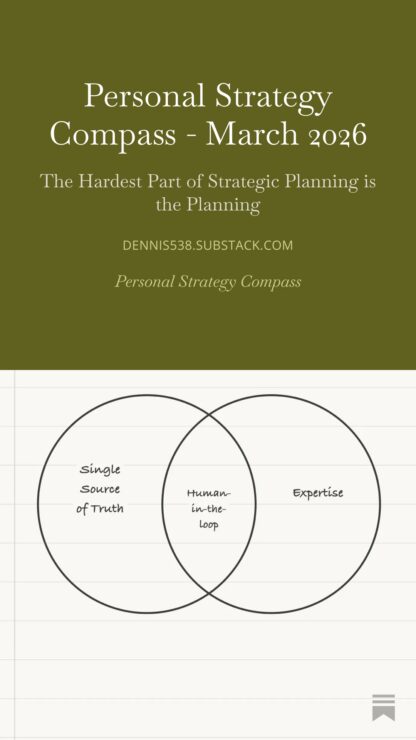
At the end of a long, technical AI session this week, something became clear to me: human-in-the-loop is being misunderstood in ways that matter.

The issue wasn’t whether the system could generate outputs quickly

Kennedy Idea Propulsion Laboratory logo

In 1980, I wrote a senior thesis paper called “Imagination: A Romantic Ideal.” My investigation then was a critique of the German and English Romantics who, in their zeal to undo the “damage” of Enlightenment Reason, merely erected a new idol: The Imagination.

Through a concrete analysis of Keats and Poe, I discovered a truth

Retiring the Scoreboard: Why I’m Done Counting Books

For many years, I ran a 52 Books in 52 Weeks challenge on my blog, usually as my first blog post of the year, which I updated each month. It was an annual public commitment, a visible signal of intellectual seriousness, and a helpful forcing function. I

I launched Personal Strategy Compass as a premium newsletter a year ago. The decision made sense on paper: quality content, established expertise, proven frameworks. But something never quite felt settled.

Not wrong, exactly. Just… misaligned.

Then I drew an Oblique Strategies card during my own quarterly planning: “Honor thy error as a hidden intention.”

If

Why Your 2026 Career Security Depends on Your December Energy Audit

As the legal market approaches the end of 2025, a pervasive, quiet anxiety has taken hold. Between the “spreadsheet economics” of law firm layoffs and the looming shadow of 2026, many senior professionals are responding with a predictable, yet dangerous, reflex.

They are working